
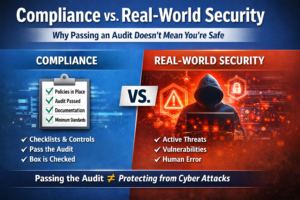
Compliance is important. But compliance alone does not equal security.
We’ve heard of organizations that passed audits and still suffered major incidents weeks later. Why?
Because compliance focuses on minimum requirements, while attackers exploit real-world gaps.
What compliance does well
Compliance frameworks establish:
• Baseline controls
• Documentation standards
• Accountability
• Consistency
They help organizations avoid chaos. But they don’t guarantee safety.
Where compliance falls short
Compliance often becomes checkbox-driven:
• Policies exist but aren’t followed
• Controls are implemented once, not monitored
• Risk exceptions pile up
• “Passing the audit” becomes the goal
Attackers don’t care if a policy exists, they exploit what actually happens.
The difference between compliant and secure
A compliant organization may:
• Have Multi-Factor Authentication (MFA) but not enforce it everywhere
• Patch systems but slowly
• Train employees but once per year
A secure organization continuously evaluates:
• What changed?
• Who has access?
• Where are we exposed right now?Aligning compliance with real security
The strongest programs use compliance as a floor, not a ceiling. They:
• Tie controls to actual threat scenarios
• Measure effectiveness, not just existence
• Update risk assessments regularly
• Empower security teams to challenge “we’ve always done it this way”
Compliance should support security, not replace it.